Steve Jobs prized secrecy from his executives and employees during his tenure at Apple. Now his top lieutenants are speaking out — to help shape the legacy of Steve Jobs.
アップルの高級幹部たちはインタビューやツイートを通じてアップルの共同設立者の新しい「非公認」伝記本『Becoming Steve Jobs』を全力を挙げて支援しはじめている。火曜日に発売されるこの本の中でアップルの幹部たちは、ジョブズ氏の死後 2011 年に発行された Walter Isaacson の公認伝記本『Steve Jobs』を批判のターゲットにしている。
Through interviews and tweets, Apple brass, including the chief executive, Timothy D. Cook, are throwing their weight behind a new unauthorized biography of the Apple co-founder, “Becoming Steve Jobs,” which goes on sale on Tuesday. In the book, executives take aim at another title, “Steve Jobs” by Walter Isaacson, an authorized biography published shortly after Mr. Jobs’s death in 2011.
* * *
その例として、 Tim Cook が「Walter Isaacson の本は彼に大きな害を及ぼしたと思います」(“I thought the [Walter] Isaacson book did him a tremendous disservice.)といったことを挙げている。
このほかにも NY タイムズの記事で Brian X. Chen は、Jony Ive が New Yorker のインタビューで(同書について)「とても好意は持てません」(My regard couldn’t be any lower.)といったことや、先週 Eddy Cue がツイッターで「これまで出た本ではいちばんよく描かれている」(Best portrayal is about to be released — Becoming Steve Jobs (book). Well done and first to get it right.)と褒めたことなどについても触れている。
* * *
アップル広報のお墨付き
「スティーブの死後長い間熟考を重ねた結果、自分たちのよく知っているスティーブについてもっと語る責任があると感じています」とアップルのスポークスマン Steve Dowling は語る。「Brent [Schlender] とスティーブの長きにわたる関係を考慮して、私たちは Brent と Rick [Tetzeli] の本に参画することにしました。そのことが彼の生涯を理解する類い稀な見方を提供できると考えるからです。この本はどの本にも増して私たちがよく知っているスティーブをよく捉えていると思います。この本に参画できてうれしく思っています。」
“After a long period of reflection following Steve’s death, we felt a sense of responsibility to say more about the Steve we knew,” Steve Dowling, an Apple spokesman, said. “We decided to participate in Brent and Rick’s book because of Brent’s long relationship with Steve, which gave him a unique perspective on Steve’s life. The book captures Steve better than anything else we’ve seen, and we are happy we decided to participate.”
『Becoming Steve Jobs』でジョブズは、思いやりのあるメンター(caring mentor)として、またチームからベストを引き出せる有能なマネージャー/権限付与者として描かれている。
“Becoming Steve Jobs” paints him as a caring mentor, as well as a delegator and skillful manager who brought the best out of his team.
* * *
いくら推奨しても
もちろんアップルの幹部たちが推奨するからといってこの本が売れるとは限らない。『Becoming Steve Jobs』もまた故パイオニアのミステリーを解き明かそうとする無数の試みに加わった本のひとつに過ぎないのだから・・・
Of course, endorsements from corporate executives hardly ensure that the book will be popular. “Becoming Steve Jobs” is the latest entry to a crowded subgenre of breathless technology books aiming to unravel the mysteries of the late pioneer […]
ウェブの死が語られて久しいが(“death of web” をググればすぐ分かる)、じつは人気がなくなったのはウェブではなくウェブブラウザなのだ。2014 年の Flurry の報告によれば、モバイルデバイスでブラウザを使った時間はたったの 14% で、残りの 86%はアプリの使用だった。
The death of the web has long been rumored (just Google “death of web”). However it’s not really the web that is losing popularity, it’s the web browser. Flurry said in its 2014 report that only 14% of time spent on mobile devices is in the browser compared to 86% in apps.
Of course, we actually spend a lot of that time in apps on the mobile web (i.e. tap a link on Twitter); it’s just that we’re accessing the web in non-browsery ways.
* * *
気づきもしないし気にもしていない
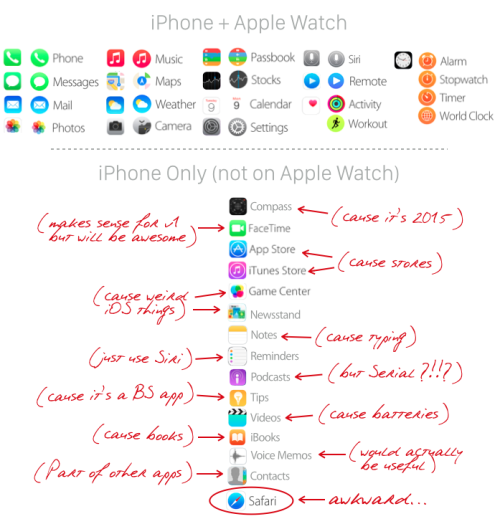
ブラウザの死はゆっくりと、だが確実に起きている。そして Apple Watch はそれにとどめを刺そうとしているのだと思う。Safari がないだけではない。そのことに誰も気づきもしなければ、気にもしていないようにみえる! もし Apple Watch に Messages や Weather や・・・Uber がなかったらどうなるか!!! きっと暴動が起きるに違いない。では Safari がなくなったらどうか? ノープロブレム。
The death of the browser has been a slow and steady process, but I believe Apple Watch will now be the nail in the coffin. Not only is there no Safari, but no one seems to notice or care! Imagine if Apple Watch had no Messages or no Weather or no… Uber!!! People would riot. But no Safari? No problem.
* * *
「ポスト電話の世界」
次にくる「ポスト電話の世界」(post-phone world)では文字通りブラウザには居場所がないのだ。では検索はどうなの?と尋ねるかもしれない。それはブラウジングを検索と錯覚した質問だ。情報が必要なら Siri に尋ねればいい。・・・あるいはグーグルだってきっと Apple Watch のためのアプリを作るに違いない。
There is just no place (literally) for browsers in our post-phone world. But what about search, you say? You are confusing browsing with searching. If you need some info, just ask Siri. Or I’m sure Google will make an app for Apple Watch too.
The point is, if Apple announced a computer with no web browser, or a new version of iOS with no web browser, or I don’t know, a new MacBook with no ports, people would freak out. Like the way they freak out about everything Apple has ever removed ever.
* * *
ブラウザのないウェアラブルの世界
しかし Apple Watch には Safari がないことに対して特段の反応もなく、そういう認識すらもないことから、アップルには当然そうする権利があり、われわれみんなもそのことを受け入れる用意があるのだと考えざるを得ない。ウェアラブルの世界にはウェブブラウザはないものだと・・・
And yet the lack of reaction, or even acknowledgement, that there is no Safari on Apple Watch, leads me to believe that not only is Apple right to not include it, but we are actually ready to accept it: a wearable world with no web browsers.
ティム・クックを CEO にするとジョブズが話した8週間後、容態は急激に悪化へと向かった。「亡くなる一週間前の金曜日、彼といっしょに映画を見ました。『タイタンズを忘れない』[Remember The Titans]を見たのです。弱小フットボールチームを扱った感傷的な映画です。そんな映画を見たいというので驚きました。『よろしいのですか?』と尋ねたくらいです。スティーブはスポーツにはまったく興味がなかったからです。いっしょに映画を見て、いろんなことについて話をしました。今日はとても楽しそうだったと思いながら帰りました。その週末を境に容態は突然悪化したのです。」
Eight weeks after Steve told Cook he was making him CEO, things took a sudden turn for the worse. “I watched a movie with him the Friday before he passed away,” Cook remembers. “We watched Remember the Titans [a sentimental football story about an underdog]. I was so surprised he wanted to watch that movie. I was like, ‘Are you sure?’ Steve was not interested in sports at all. And we watched and we talked about a number of things and I left thinking that he was pretty happy. And then all of a sudden things went to hell that weekend.”
“This picture of him isn’t understood,” says Cook. “I thought the [Walter] Isaacson book did him a tremendous disservice. It was just a rehash of a bunch of stuff that had already been written, and focused on small parts of his personality. You get the feeling that [Steve’s] a greedy, selfish egomaniac. It didn’t capture the person. The person I read about there is somebody I would never have wanted to work with over all this time. Life is too short.
“Steve cared,” Cook continues. “He cared deeply about things. Yes, he was very passionate about things, and he wanted things to be perfect. And that was what was great about him. A lot of people mistook that passion for arrogance. He wasn’t a saint. I’m not saying that. None of us are. But it’s emphatically untrue that he wasn’t a great human being, and that is totally not understood.






 maclalala2